
Seeking support for your mental health can be an important step towards improving your wellbeing. However, many people are unsure whether they should see a psychologist or a psychiatrist. While both professionals support people experiencing mental health challenges, they provide different types of care and treatment.
Understanding these differences can help you navigate the mental health system and access the support that best meets your needs.
Understanding the Difference
Psychologists and psychiatrists are both highly trained mental health professionals, but their roles are distinct.
When Might Someone Consider Seeing a Psychologist?
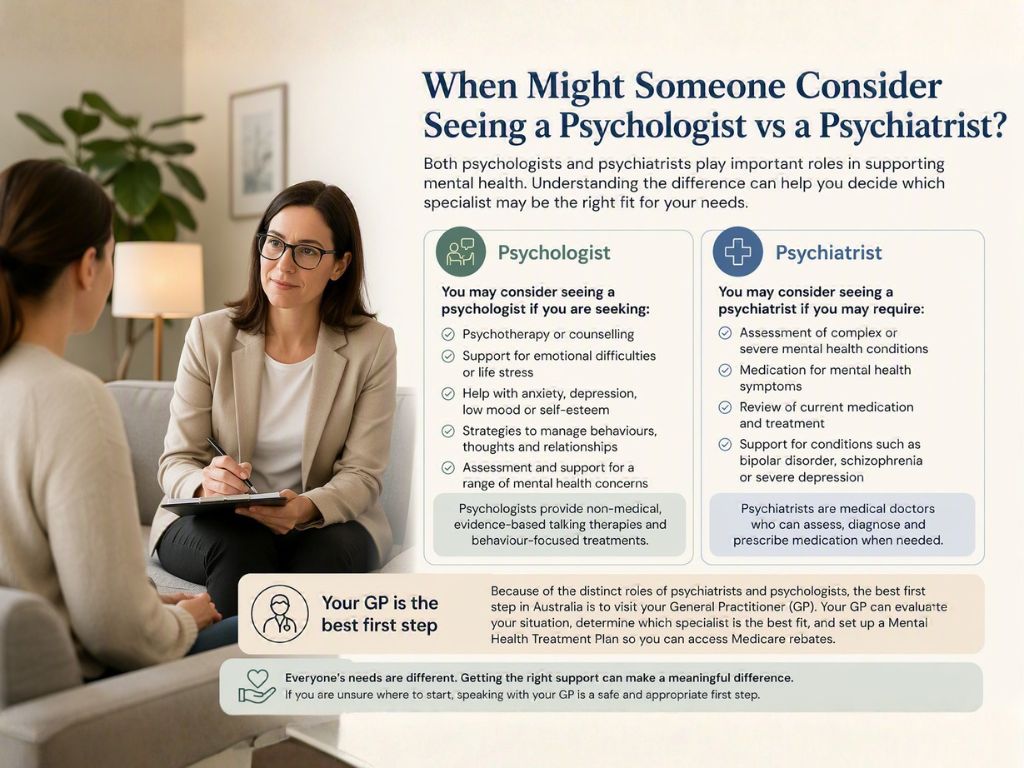
A psychologist focuses on understanding thoughts, emotions, and behaviours and uses evidence-based psychological therapies to help people manage challenges and improve their wellbeing.
Common reasons for seeing a psychologist include:
- Seeking psychotherapy (talk therapy)
- Counselling and emotional support
- Managing anxiety, stress, or depression
- Developing coping skills and resilience
- Addressing relationship or family difficulties
- Working through grief and loss
- Managing workplace stress or burnout
- Behaviour-focused treatments and interventions
- Adjusting to major life changes or transitions
Psychologists help individuals identify patterns in their thinking and behaviour and develop practical strategies to create meaningful and lasting change.
For many people, psychological therapy can provide a safe space to explore challenges, build self-awareness, and improve overall mental health.
Considering this topic further?
Some people who relate to these experiences may consider exploring psychological support depending on their situation.
Learn more about psychology services in Brisbane and telehealth options
When Might Someone Consider Seeing a Psychiatrist?
A psychiatrist is a medical doctor who specialises in mental health.
In addition to assessing and diagnosing mental health conditions, psychiatrists can prescribe medication and provide medical treatment when required.
You may consider seeing a psychiatrist if:
- Your symptoms are severe or significantly affecting daily life
- You may require medication as part of your treatment
- Previous therapies have not provided sufficient improvement
- You require a comprehensive psychiatric assessment
- You have a complex or long-term mental health condition
- Ongoing medication monitoring and management are needed
Psychiatrists commonly assist people experiencing conditions such as:
- Major depressive disorder
- Bipolar disorder
- Schizophrenia and psychotic disorders
- Severe anxiety disorders
- Attention-Deficit/Hyperactivity Disorder (ADHD)
- Other mental health conditions that may benefit from medical treatment
In many cases, psychiatrists and psychologists work together to provide comprehensive care.
Do You Need a Psychologist or a Psychiatrist?
The answer depends on your individual circumstances.
As a general guide:
A psychologist may be appropriate if you are:
✅ Looking for counselling or psychotherapy
✅ Seeking strategies to manage emotions, thoughts, or behaviours
✅ Experiencing stress, anxiety, relationship difficulties, or life challenges
✅ Wanting support to improve coping skills and emotional wellbeing
A psychiatrist may be appropriate if you:
✅ May require medication
✅ Have severe or complex symptoms
✅ Need a psychiatric diagnosis or medical assessment
✅ Require ongoing medical management of a mental health condition
It’s important to remember that many people benefit from both psychological therapy and psychiatric care.
Exploring support options
For some people, understanding these experiences may lead to exploring different support options.
Takes Care Specialist Centre provides psychology services in Brisbane and telehealth options across Australia. Support approaches vary depending on individual circumstances.
Why Your GP Should Be Your First Step
Because psychologists and psychiatrists have different roles, the best first step in Australia is usually to visit your General Practitioner (GP).
Your GP can:
- Discuss your symptoms and concerns
- Assess your overall mental health
- Identify any physical health factors contributing to your symptoms
- Determine whether a psychologist, psychiatrist, or both may be appropriate
- Provide referrals to suitable specialists
- Develop a Mental Health Treatment Plan
A Mental Health Treatment Plan may allow eligible individuals to access Medicare rebates for psychological services, helping reduce the cost of treatment.
Rather than trying to decide on your own which professional you need, your GP can help guide you towards the most appropriate care pathway.
There Is No Wrong Place to Start
Mental health challenges affect people differently, and there is no single treatment approach that works for everyone.
Some people benefit from psychotherapy and counselling with a psychologist. Others may require medical assessment and treatment from a psychiatrist. Many people find that a combination of both provides the most effective support.
The most important step is reaching out for help when you need it.
Final Thoughts
Psychologists and psychiatrists both play valuable roles in supporting mental health, but they provide different types of care.
If you are primarily seeking psychotherapy, counselling, or behaviour-focused treatments, a psychologist may be the right place to start. If your situation may require medical assessment, diagnosis, or medication management, a psychiatrist may be more appropriate.
If you’re unsure which professional is best suited to your needs, speak with your GP. They can assess your circumstances, recommend the most appropriate specialist, and help you access support through a Mental Health Treatment Plan and available Medicare rebates.
Seeking help is a positive step towards better mental health, and support is available when you need it.